
Jul 2026
PhD Advisor: Professor Matthew McCabe
Abstract:
Globally, mangroves are among the most efficient ecosystems to store carbon per unit area, with the majority of this held in the soil. However, the factors controlling mangrove soil organic carbon (SOC) in the environments of the arid Arabian Gulf are not well quantified. This thesis examines SOC variability across five mangrove sites in the Eastern Province of Saudi Arabia: Abu Ali, Ras Tanura, Safwa, Tarout, and Seihat. It also evaluates the environmental and human influences that may explain this variability. Field measurements of stand structure from 37 biometric plots and soil carbon from 15 sampling points, including 45 samples collected to a depth of 50 cm, were combined with site level water chemistry and Planet 3 m and Landsat 30 m satellite imagery. Total SOC stocks from 0 to 50 cm ranged from 66.9 Mg ha -1 at hypersaline Abu Ali to 134.1 Mg ha -1 at Tarout. The southern sites, which were influenced by treated wastewater and freshwater, stored almost twice as much carbon as the hypersaline northern sites. Salinity had the strongest relationship with SOC (r = -0.91). From a plant structural perspective, stem diameter showed a closer relationship with carbon storage than tree density, which suggests that water source affects SOC mainly through its influence on stand development. Remote sensing showed substantial mangrove expansion since the mid 1980s and mapped a current extent of about 466 ha across the five sites. It also showed that canopy greenness does not always correspond with soil carbon, especially in young plantations such as Abu Ali. The findings support a restoration and blue carbon management framework based on water source in arid coastal environments. They also identify aboveground biomass estimation and verification using drones as priorities for future research.
Bio:
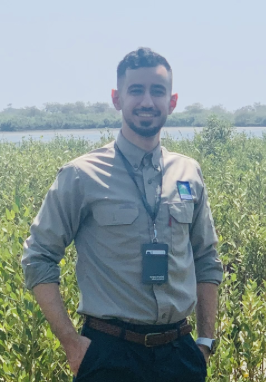
Hassan Alkhunaizi is a Senior Environmental Sustainability professional with 8 years of experience at Saudi Aramco, working in environmental protection, sustainability, and nature-based solutions. He is currently a Master’s student in Environmental Science and Engineering at KAUST, working under the supervision of Professor Matthew McCabe. His work focuses on mangrove restoration, carbon quantification, carbon credits, and environmental project development. He has been involved in several environmental projects in Saudi Arabia, including mangrove plantations, carbon sequestration, eco-parks, and technology-based monitoring solutions. Hassan is passionate about connecting fieldwork, research, and practical sustainability work to support conservation, climate action, and long-term environmental impact.