
Oct 2026
Abstract:
Progress and Challenges in Hydrology
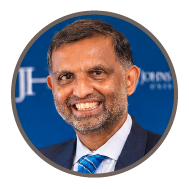
Venkataraman (Venkat) Lakshmi
B Howell Griswold Professor of Geography and International Affairs
Environmental Health and Engineering
Johns Hopkins University
President, Hydrology Section, American Geophysical Union
In order to study land surface hydrology, we need to use a multitude of tools, namely, modeling, observations and their synergism. After multiple decades of hydrological modeling, we still have major challenges. However, we have novel observations and mathematical methods that are now available and can be harnessed to achieve progress. These include earth observations that are available at global scales and at high spatial resolutions and frequent temporal repeat. Artificial Intelligence and Machine Learning (AI/ML) can be used (specifically Transfer Learning) to determine streamflow in un-gaged or poorly-gaged watersheds.
In this talk, I will focus on four major questions and provide examples for each of the questions. These examples will highlight both advances and limitations for each issue.
(i) Do earth observations compare well with in-situ counterparts?
(ii) How important is rainfall in hydrological modeling?
(iii) Can we get higher spatial resolution of earth observations?
(iv) How do we study un-gaged/poorly gaged watersheds?
Bio:
Venkat graduated from University of Roorkee in 1987 with a Bachelor degree in Civil Engineering and a Doctorate in Civil and Environmental Engineering in 1996 from Princeton. He worked at NASA Goddard Space Flight Center 1996-1999 as a research scientist in the Laboratory for the Atmospheres.
His areas of research interest are catchment hydrology, satellite data validation and assimilation, field experiments, land-atmosphere interactions, satellite data downscaling, vadose zone and water resources and linkage between environmental variability and disease. He uses a combination of earth observations, physical models and AI/ML methods.
From 2019-2026, He served as the John L Newcomb Professor of Engineering in the Department of Civil and Environmental Engineering at the University of Virginia. He has served as Cox Visiting Professor at Stanford University 2006-2007 and 2015-2016 and Program Director for Hydrologic Sciences at the National Science Foundation (2017-2018).
Venkat is a fellow of the American Society of Civil Engineers (ASCE), Geological Society of America (GSA), American Society of Agronomy (ASA), American Association for the Advancement of Science (AAAS), American Meteorological Society (AMS) and he has over 250 peer-reviewed articles and around 600 presentations and thesis supervisor for 25 graduate students. He is currently serving as editor for Vadose Zone Journal and the founding editor-in-chief of Remote Sensing in Earth System Science (Springer Journals). He has served on the National Academies Panel for the Decadal Survey of Earth Observations from Space (NASA) and as chair of the planning committee for Groundwater Recharge and Flow: Approaches and Challenges for Monitoring and Modeling Using Remotely Sensed Data (NGA). He is currently serving as a member of the Water Science and Technology Board, National Academy of Sciences and past Vice-Chair of the Earth Science Advisory Committee for NASA. He is the President of the Hydrology Section of the American Geophysical Union
Venkat is currently the Benjamin Howell Griswold Professor of Geography and International Affairs in the Department of Environmental Health and Engineering in the Whiting School of Engineering at Johns Hopkins University.