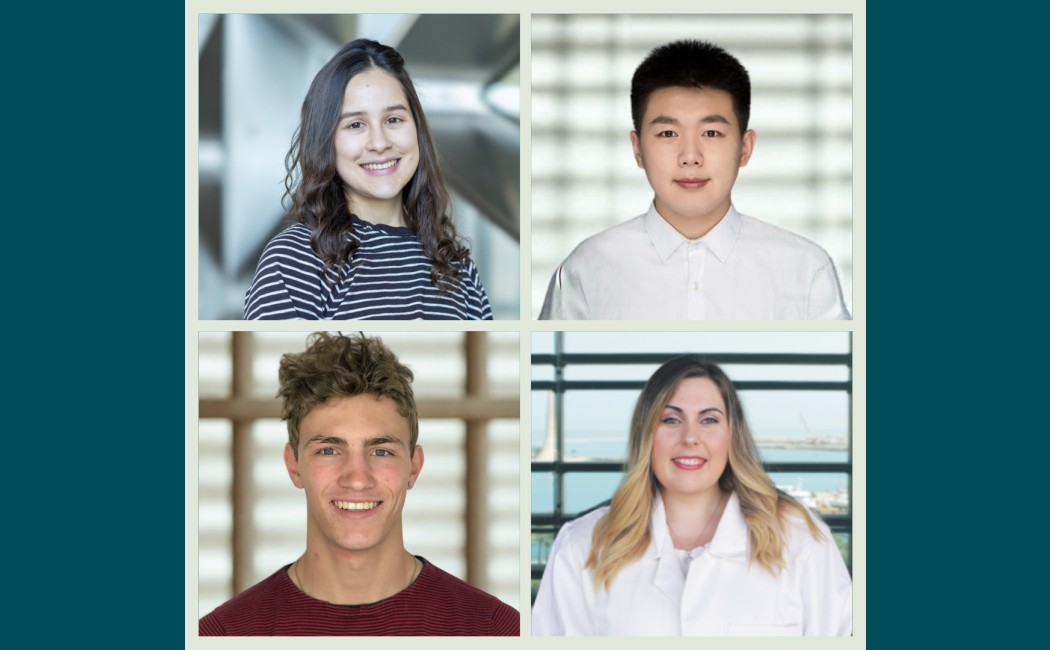
Dean’s Travel Award Recipients
27 January, 2026
The Dean’s Travel Award recognizes a select number of BESE graduate students whose research is demonstrating exceptional quality and momentum. The award supports these students in presenting their work at leading international conferences, where they share new findings, engage with global research communities, and contribute to scientific dialogue in their respective fields.
This year’s recipients reflect the strength of graduate research within BESE. Through work addressing coral reef processes, coral disease, crop–pathogen interactions, and plant adaptation to extreme environments, they are advancing research that is being discussed and evaluated on international platforms. The Dean’s Travel Award enables their work to reach a broader audience and supports their development as emerging researchers within the global scientific community.
Gage
Mele
PhD
Student, Marine Science
Advisor: Michael D. Fox
Conference: Ocean Sciences Meeting (OSM), Glasgow
Research
focus
Gage’s research
challenges long-standing assumptions about how coral reefs function. While
reefs were once considered largely self-sustaining, his work demonstrates that
they rely heavily on external pelagic food sources that are significantly
underestimated by satellite observations.
By combining 15
months of biweekly in situ sampling across the Red Sea and Tropical Pacific
with advanced Bayesian modeling, Gage showed that satellites can underestimate
pelagic productivity near reefs by more than 80 percent. His findings reveal a
vast, previously overlooked deep chlorophyll resource pool that plays a
critical role in reef resilience and post-bleaching recovery.
Presenting
this research internationally
At the Ocean Sciences
Meeting, a leading global conference in oceanography, Gage will present his
findings to researchers specializing in ocean optics, remote sensing, and reef
ecology. Engaging with this community will allow him to receive expert feedback
on his methods and interpretations and to situate his work within broader
efforts to understand how pelagic processes influence coral reef ecosystems.
Student
quote
“Ocean Sciences
Meeting is the leading conference in marine science and brings together
experts from the fields of oceanography, marine ecology, and sustainability to
discuss the most pressing topics in ocean science.
Laura
Beenham
PhD
Student, Marine Science
Advisor: Raquel S. Peixoto
Conference: International Coral Reef Symposium (ICRS),
Auckland
Research
focus
Laura’s research
addresses one of the most urgent and least understood drivers of coral reef
decline: disease. Her work provides one of only a handful of experimentally
confirmed demonstrations worldwide identifying a microbial pathogen responsible
for coral disease using Koch’s postulates.
By isolating,
sequencing, and experimentally validating Vibrio owensii as the
causative agent of rapid tissue loss in Acropora hemprichii, Laura has
made a rare and significant contribution to coral disease ecology. Her
interdisciplinary approach integrates coral husbandry, microbial genomics,
infection assays, and environmental stress experiments, advancing the
scientific foundation needed for effective reef management and restoration.
Presenting
this research internationally
The International
Coral Reef Symposium is a primary global forum for coral reef science.
Presenting this work at ICRS allows Laura to share a rare experimental
validation of a coral disease pathogen with the international research
community, engage with experts in coral disease and reef management, and
contribute to ongoing discussions on microbial approaches to reef conservation.
Student
quote
“Receiving the Dean’s
Travel Award is such an honour. It gives me the opportunity to present my
research on a newly described coral pathogen at an international conference in
New Zealand, helping to support restoration efforts by improving our ability to
combat coral disease.”
Natalia
Arango López
PhD
Student, Plant Science
Advisor: Simon G. Krattinger
Conference: International Wheat Congress (IWC), Perth
Research
focus
Natalia’s research
explores one of the most durable forms of disease resistance in crops: non-host
resistance. Her work has revealed a conserved molecular mechanism that enables
plants such as barley to resist fungal pathogens that devastate related cereal
crops.
By identifying
glycoside hydrolase enzymes as key ligands recognized by receptor kinases,
Natalia has helped demonstrate that this resistance mechanism is conserved
across multiple cereal species. This discovery advances understanding of
plant–pathogen interactions and opens pathways for engineering durable disease
resistance in major food crops.
Presenting
this research internationally
The International
Wheat Congress brings together scientists, breeders, and industry leaders
working across wheat research and crop improvement. Presenting at this forum
enables Natalia to share her findings with a broad international audience and
to engage with researchers focused on translating disease resistance mechanisms
into future breeding strategies.
Student
quote
“Attending this
year’s International Wheat Congress is a key opportunity for my career
development. This biennial conference serves as a platform for advancing
discussions on wheat-pathogen interactions and their implications for global
food security, which are central to my PhD research. By winning the Dean’s
Travel Award I get to represent KAUST by sharing our advances in the field with
the global wheat research community!”
Yunchuan
Wang
PhD
Student, Plant Science
Advisor: Mark Tester
Conference: Plant Biology 2026, Ottawa
Research
focus
Yunchuan’s research
focuses on understanding how extreme halophytic plants such as Salicornia
tolerate and manage high salinity. Using comparative genomics and
transcriptomics, he investigates how these plants compartmentalize sodium in
shoot tissues, preventing cellular toxicity.
By developing multiple Salicornia genomes, Yunchuan has identified candidate genes linked to salt tolerance. His work contributes new insights with implications for improving crop resilience on salt-affected soils worldwide.
Presenting
this research internationally
Plant Biology is one
of the largest annual conferences in plant science, bringing together experts
across genomics, physiology, and stress biology. Presenting his work at this
meeting enables Yunchuan to engage directly with researchers working on plant adaptation
to extreme environments and to place his findings within a wider international
research context.
Student
quote
“Dean’s Travel Award
means I can bring my research on Salicornia—a halophyte—to an
international plant biology conference. It will give me the opportunity to
present and promote our research, receive valuable feedback from experts in
related fields, and learn about new techniques and recent advances.”