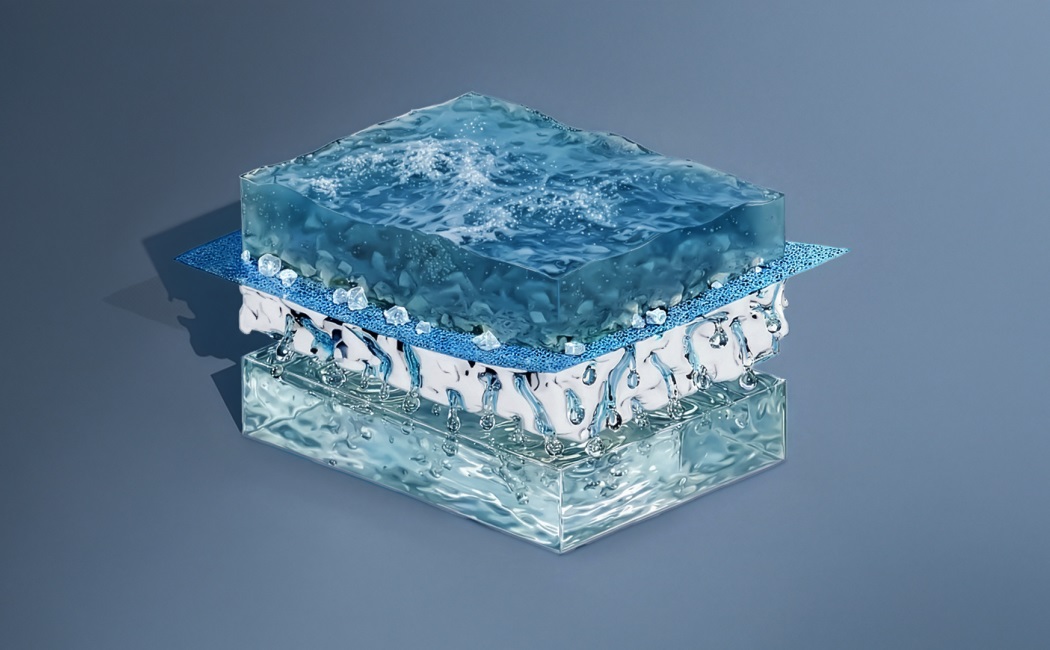
Ultrathin water repellent membrane advances desalination
10 February, 2026
Technologies capable of generating freshwater efficiently and cost-effectively are critical for reaching sustainability goals, particularly in arid regions such as the Middle East. Researchers have now developed a polymeric membrane that can desalinate seawater and brines at ambient temperature and pressure. The work was carried out by an international research team led by scientists at King Abdullah University of Science and Technology (KAUST).
“Water scarcity is severe in Saudi Arabia and is reaching unprecedented levels in countries once thought to be safe from such pressures,” says Noreddine Ghaffour, who led the research. “We urgently need to produce freshwater from seawater and brines at any scale, efficiently and cost-effectively, while conserving energy.”
Conventional membrane-based technologies such as reverse osmosis are most cost-effective at very large scales and depend on sophisticated energy-recovery systems. Even under these conditions, treating highly concentrated brines remains difficult because of the extreme pressures required. Membrane distillation offers an alternative approach, but it typically relies on elevated temperatures to vaporize water before it passes through a membrane and condenses as freshwater.