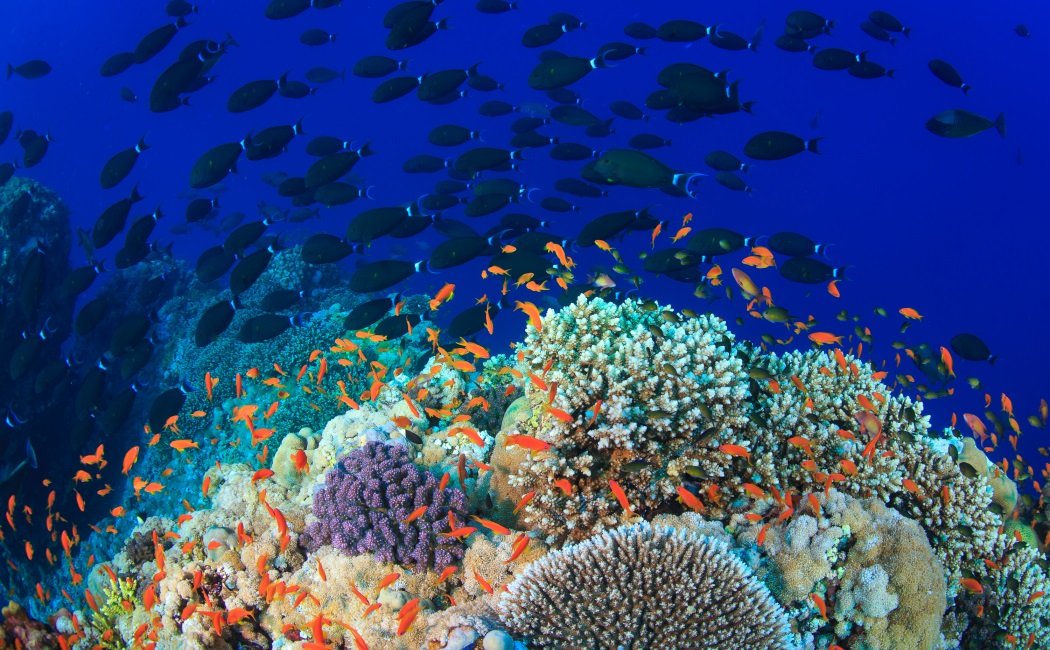
KAUST researchers call for accelerated global action to safeguard coral reefs under climate change
21 May, 2026
A new international study co-authored by researchers at King Abdullah University of Science and Technology highlights the urgent need to accelerate research and application of coral assisted evolution strategies to help coral reefs survive intensifying climate change.
Published in Nature Reviews Biodiversity, the paper brings together an international team of experts, including several scientists from KAUST’s Biological and Environmental Science and Engineering (BESE) division, to assess how emerging biological and ecological tools can enhance coral resilience in a rapidly warming ocean.
KAUST co-authors include Professors Carlos M. Duarte, Manuel Aranda, Raquel S. Peixoto, and David J. Suggett, all of whom contribute expertise spanning coral ecology, microbial symbiosis, reef restoration, and climate adaptation science.
Coral reefs are among the most vulnerable ecosystems to ocean warming, with increasingly frequent marine heatwaves driving large-scale bleaching events worldwide. The authors emphasize that while conventional conservation approaches remain essential, they may need to be complemented by innovative strategies such as assisted evolution, selective breeding, and microbiome-based interventions to address the pace and scale of climate change.
The study outlines a roadmap for accelerating progress in this field, emphasizing the need for coordinated international research efforts, improved scaling of promising solutions, and stronger integration between laboratory science and real-world reef restoration.
The work was funded by the Global Coral R&D Accelerator Platform (CORDAP), headquartered at and supported by KAUST, which supports international collaboration to develop and scale solutions for coral conservation and restoration.
“Climate change is progressing faster than many coral populations can naturally adapt,” said Aranda. “Reducing greenhouse gas emissions remains essential, but we also need to accelerate research into approaches that can strengthen the natural capacity of corals to persist in a rapidly changing ocean. The challenge now is moving promising ideas from the laboratory toward real-world solutions that can support reef conservation where it matters most.”
Peixoto added: “The Red Sea offers a unique natural laboratory for understanding coral resilience under extreme conditions. At KAUST, our goal is to translate this knowledge into practical, science-based tools that can support assisted coral reef conservation and restoration in the Red Sea and globally.”
KAUST’s contribution reflects the university’s growing leadership in coral reef science and its strategic focus on developing science-based solutions to environmental challenges in the Red Sea and beyond.
Photo credit: Tane Sinclair-Taylor